
This Black History Month, Touchstone have been interviewing prominent figures in our local Black communities to reflect this year’s theme of Honouring our Communities. Our second interview is with Claude Hendrickson MBE, a Leeds-based activist, Community-led housing advisor, and speaker. Read on to find out more about Claude’s work and how he thinks mental health services, funders and commissioners can better support Black communities.
-
Tell me about your work, when it started and why?
I was born here in 1960 to the first generation of migrants to Chapeltown, known as the Windrush Generation. My activities in the community started when I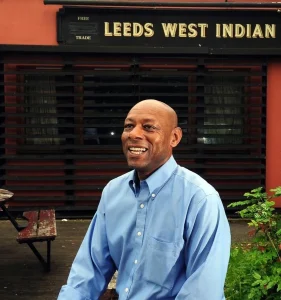 was around 15/16 and I helped set up the first youth association in Chapeltown at aged 19. We realized that generic youth work doesn’t work for us, for our community. We were a new generation of kids growing up here and we needed something specific and specialist. What was in place already – groups with table tennis, football, table football, playing cards – wasn’t quite right for us. So that’s why we started our group and included things like Sound Systems and other activities for our young people.
Chapeltown and Harehills Liaison Committee
Since then, I’ve been involved in a range of activities in my community. I became the first youth chair for the Chapeltown and Harehills liaison committee, which was set up in response to the nationwide riots in 1981 that took place in Chapeltown and places like Handsworth, Toxteth, Moss Side, Manningham in Bradford and other areas. The committee mirrored the local council departments – there was somebody to represent housing, employment, training, health, youth etc. This came after the then-Thatcher government gave £1million in funding to 8 communities, one of which was Chapeltown.
Frontline Self-Build Project
With that experience and funding, I set up the Frontline Self-Build Project. Frontline Self-Build was a group of unemployed, badly-housed young Black men who got together to build their own houses, solve their housing issues, and get employment skills in construction. Many people from that project then went on to work in construction. This challenged the stereotypical views of Black men at the time – that we didn’t want to work, that we were anti-social. That was really when I came of age – after my children, that project is my greatest achievement. It proved that a group of Black men working together can solve their housing issues and become employable. It also inspired several community-led housing projects in Leeds like LATCH, Canopy, the Lilac Housing Project. I’m really proud of our role in that legacy. In 2015, I was also commissioned by Leeds City Council to do a 10-year strategy for community-led housing in Leeds.
Chapeltown Young People’s 10:2 and Yes Cyber Clubs
Following that, on 4th January 2000, I set up Chapeltown Young People’s 10:2 club, which was a Millenium Project. There weren’t many facilities for engaging young people from the age of 16, especially after 9pm. So, for 2 nights a week we set up a space where we could sit down with young people and ask them what they needed. Out of that came a project called Yes Cyber, which was an internet access point on Chapeltown Road – the first of its kind in Leeds – with Thomas Danby college and Unity Housing. We set it up there because young people had said that everything was hidden behind buildings, they wanted something on the high street, where young people could be engaged, come in and look for college and employment opportunities.
In the discussions with young people, we also realized that the biggest corruptor of disadvantaged young people was the 6 weeks holiday. Parents didn’t have the money to take them on holiday or do stuff with them, so they ended up walking around the streets. We went on to start running a summer programme for young people to give them at least three weeks of activity during the summer holidays. We got them first aid and food hygiene certificates and arts and culture training and activities. We took them to theme parks and attractions right across the country, including the London Eye and the Houses of Parliament. We also set up an after-school club aimed at 14–16-year-olds, where young people could come down to the Mandela Centre and get support with homework with support from tutors. We had to close that down in 2012 because of all the austerity cuts and council cuts – funding was taken away from us.
Other Community, Research and Advisory Work
During that time, I was also the Director of the Leeds Bicentenary Project – celebrating 200 years of the abolition of slave trade. This was a big project at the African-Caribbean Centre (formerly the West Indian Centre).
I then went on to do a piece of research called the Race Card project, where we looked at how far the Black community has come since we moved here with the Windrush Generation. We looked at this in Leeds, Huddersfield, Bradford, and Wakefield across four themes: education, employment and training; police and community; media; and health and wellbeing. What we looked at was how different Black communities in these areas tackled those four issues over the last 30-40 years. We also created a media toolkit from this in 2013-14 around how communities use social media and new media platforms.
Throughout the years, I have also been the youngest Chair of Chapeltown Citizen Bureau and a founding member of Leeds Reggae Concert (now Leeds Black Music Festival), which takes place on Carnival weekend and was 40 this year!
In my later life, I trained to become the first Black male Community-Led Housing accredited advisor in the UK. For this I travel nationally, running workshops on opportunities around community-led housing, co-ops, and co-housing. I also became a Community Land Trust ambassador, which is about highlighting that communities can take control of spare land and housing in their community as their own. I am also a community champion for the ‘we’re right here’ campaign network and advocate for a range of community-wealth building interventions.
- In what ways do you think your work is making a difference in the community?
I am a firm believer in collecting evidence of what can be achieved when our community is supported – instead of the community being seen as the problem! I’m a big believer in how we can support each other to be part of the solution.
Out of all those projects I’ve done – there have been good role models created, good examples for the young people with what can be achieved with the right kind of support. Within the projects, we have done a lot of good practice that can be shared with other people who want to do similar projects.
- What do you think wellbeing and mental health services need to understand better and do differently to genuinely support Black communities?
Services need to be willing listen to us and understand the trauma of systemic racism, the trauma of negative press about Black people. They all serve to undermine the Black community’s contribution to the UK.
We need support fighting negative press and negative stereotypical views of a community. The systemic racism and hostile environment have a negative impact on people’s mental health and wellbeing.
We need to look at some of the positives that we have contributed to society since we have been in the UK – how Black communities are central to our NHS, to public transport – buses and British rail, to the social housing sector, to our football teams!
- How can funders and commissioners better support Black communities’ health and wellbeing in Leeds and beyond?
Funders and commissioners and institutions can come and sit and down and understand the needs of communities more. We want to work with all groups to find solutions to problems. We as parents, we as community members, we as community advocates, we want to see the best for our community. We need people to listen to us about what we need and support us to find solutions.
I also want to say that when we say ‘community’ – there are many non-Black people living in our communities that we want to work with. I was brought up in the era of ‘no Blacks, no dogs, no Irish’. Over the years, we have had some fantastic Irish allies, Scottish allies, English allies over the years. Our vision is not just to find solutions for ourselves but to find solutions for the whole of the communities that we live in.
- What are you most proud of in your local community?
I’m really proud of what our community has brought to Leeds and the UK. I always say Chapeltown is the spice of Leeds. We have brought one of Europe’s biggest cultural events to the city of Leeds in Leeds’ West Indian carnival. We have supported this with dance groups, which encouraged the Northern School of Contemporary Dance.
Some of our elder states people have gone on to get MBEs, keys to the city, and honorary doctorates for our contribution to the city. We haven’t let adversity stop us from trying to have a positive contribution to the city – and we have had one.
- Is there anything else you’d like to mention?
I’d like to mention my mother, who passed away two years ago, and say that she was my greatest supporter, my greatest inspiration. A lot of the work I’ve done was to make my mother proud of me. It’s important that I mention her. Making my children proud of me is important too. But my mother went through a hell of a lot to help me get where I am today.
I also feel I’m an example here, challenging myths around people that don’t have fathers, myths that they will do negative things. My father left when I was 2 and that didn’t stop me. I’m an example of growing up without my father – and making a success my life.
You can learn more about Claude’s work on his website.