
Between September 2024 and January 2026, Touchstone’s Tracey Hemmerdinger undertook research into how to make Crisis Alternative Services more inclusive spaces for neurodivergent people and people with learning difficulties. This research was commissioned by NHS England to inform a workforce development strategy for the Voluntary, Community and Social Enterprise (VCSE) crisis alternative sector.
Our full report is now live – read our full report here and read on to find out more about our key findings.
Aims of the research
This research aims to ensure that community-based crisis services are better equipped to meet the needs of neurodivergent people and people with learning difficulties. It explores the experiences of neurodivergent individuals and the heightened barriers they face when accessing crisis care. It then looks at what crisis workforces need to address these barriers and make their services as safe, welcoming, and supportive as possible.
The study is part of the NHS’s long-term shift towards community-based mental health provision and alternatives to inpatient admission.
Research methods
The research used a mixed-methods approach to capture both breadth and depth of experience across the North East and Yorkshire region. Methods included co-produced questionnaires, focus groups, semi-structured interviews, case studies, and a regional audit of crisis alternative provision.
In total, 410 participants contributed, including neurodivergent adults, children and young people (CYP), parents and carers, crisis alternative staff, keyworkers, and other stakeholders from minoritised communities. Particular effort was made to include groups less likely to access mainstream services, such as care-experienced young people, refugees, LGBTQ+ individuals, and people from ethnically and culturally diverse communities. The report adopts a neurodiversity-affirming approach, using carefully considered language and privileging the voices of Experts by Experience.
Research results: the current picture
Across all groups, the research shows that feeling heard, understood and accepted is the most critical factor in effective crisis support for neurodivergent people. Crisis alternatives are valued but are inconsistently available, poorly understood, and often inaccessible to those who need them most.
There is a clear mismatch between how services believe they are operating and how neurodivergent people experience them. This gap is compounded by intersectional factors such as age, gender identity, ethnicity, disability, and socioeconomic status.
The results demonstrate that improving crisis care for neurodivergent people requires:
- Accessible, predictable, non‑clinical environments
- Multiple communication routes and clear information
- Workforce development at an advanced level, not basic awareness
- Inclusion of families and carers
- Targeted provision for children, young people and transition age
- Cultural competence and outreach to marginalised communities
Overall, the findings reinforce that crisis prevention and response for neurodivergent people is not solely a training issue, but a workforce, system design and equity issue that requires coordinated action across commissioning, service design and training.
For a breakdown summary of results for each group we spoke to, please access our summary report here.
Findings
Training needs
Our report finds that staff need more advanced, lived-experience-led training on how to better understand and support neurodivergent service users, including an understanding of intersectionality. Without sustained investment in training and reflective support, crisis services are unlikely to deliver equitable or safe care for neurodivergent people.
Improved service design
The research also shows that how services are designed and accessed is as important as who delivers them. Overall, the report found that crisis alternatives work best when they are flexible, low‑threshold, relational and community‑embedded, rather than tightly bounded, phone‑based or clinically framed. Neurodivergent people expressed a strong preference for non-clinical, calm, predictable environments with staff continuity, joined-up holistic support before, during, and after crisis, and clear information about the service to reduce sensory overload and anxiety. Research also found a significant shortage of crisis alternative provision for children and young people.
Other key findings
Other key findings highlight wider system issues. In summary, the report found that crisis support for neurodivergent people cannot be improved through workforce development alone; it requires coordinated action on language, access, culture, prevention and community trust. Risk is often increased not by neurodivergence itself, but by misunderstanding, inaccessible environments, poor communication and lack of timely support, which requires an investment in training, supervision, and improved infrastructure to change.
The research also shows that intersectionality significantly shapes crisis experience: neurodivergent people who are also LGBTQ+, from ethnically and culturally diverse communities, refugees, care leavers or disabled face compounded stigma, mistrust and access barriers.
For a more in-depth overview of findings, please read our report summary on our Inclusive Crisis Alternatives webpage here.
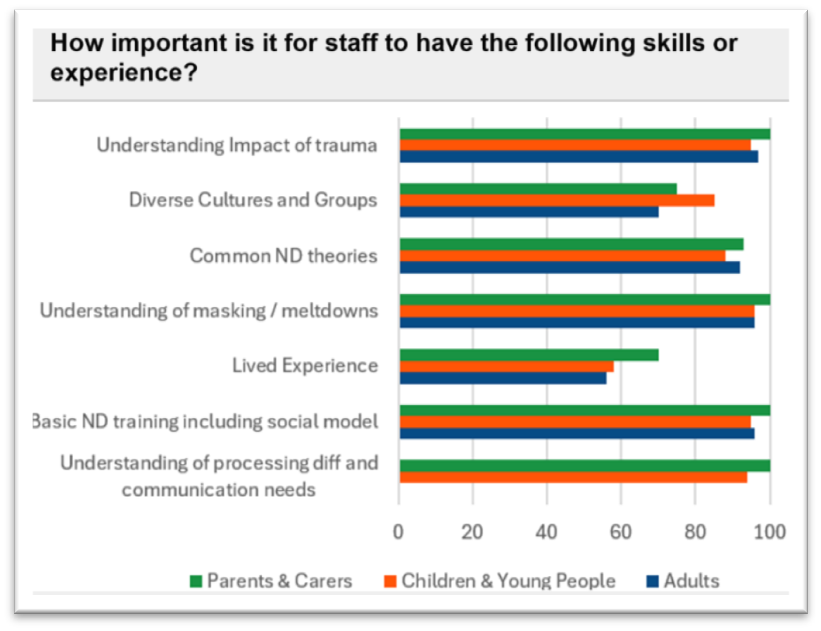
Training Identified as necessary by neurodivergent people
Training and resource pack
In response to the research results, Touchstone have developed a a 7- hour face-to-face training and an accompanying resource pack. This pack was created with staff from Touchstone’s crisis alternative provision, Here For You. The training was evaluated with pre and post event questionnaires. The results showed a significant increase in knowledge and a corresponding confidence in ability to deliver a good service. After the training people rated their knowledge of neurodivergence as good or very good in 97% of responses
A resource pack has been co-produced with Experts by Experience and included in the training. It includes a range of recommendations, information and practical resources for use in crisis alternative settings.
For details on how to access training and resource pack please email: learningandtraining@touchstonesupport.org.uk

Front cover of pilot resources pack.
Conclusion
The report concludes that crisis alternative services have a vital role in preventing hospital admission and supporting neurodivergent people, but they cannot succeed without sustained investment in workforce development, accessibility, and inclusive service design. Training, including a resource pack was piloted and produced encouraging results. However, training alone is not sufficient; commissioners must also address structural barriers such as service availability, communication methods, cultural competence, and timely access.
Key recommendations include fully funded, advanced neurodiversity training for all crisis staff; embedding reflective practice; improving crisis provision for children, young people and parents; and commissioning more flexible, community-based, and culturally responsive models. Listening to neurodivergent people—particularly those most marginalised—and acting on their feedback is essential to delivering equitable, effective crisis care.
To find out more about this research and read the report in full, please visit our Inclusive Crisis Alternatives webpage here.